
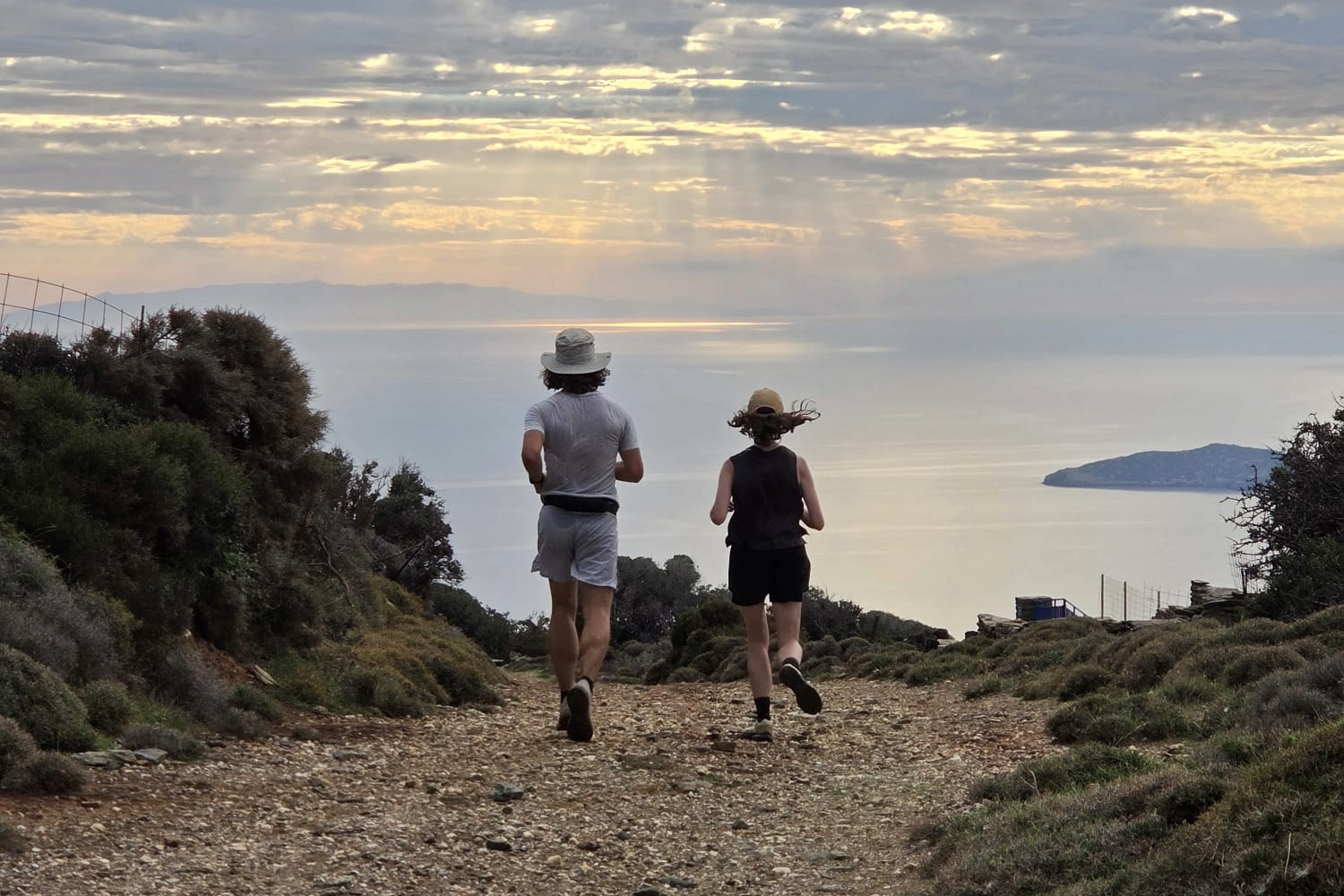
There is a particular kind of serenity you only find on a trail climb. Footsteps soften on dirt. Breathing grows rhythmic. The world narrows to the next bend in the path. For many runners, this is where the sport begins to feel less like exercise and more like exploration.
Trail running offers something the road often cannot: variation, texture, and immersion. The terrain changes constantly. Your attention sharpens. Instead of chasing splits on a watch, you respond to the landscape. Hills invite you to hike. Descents ask for control. Forests, ridgelines, and open sky replace traffic lights and sidewalks. The experience becomes less about pace and more about presence.
For beginners, however, trails and mountains can feel intimidating. Uneven ground, steep climbs, and the word “mountain” itself can create the impression that this is a realm reserved for elite athletes. In reality, trail running is often more forgiving than road running. Softer surfaces reduce repetitive impact. Hiking is not only acceptable but encouraged. Effort naturally fluctuates with terrain, which makes it easier to stay aerobic. You are allowed to slow down. You are allowed to walk. You are allowed to learn.
Stepping off the road and onto trails does require more than enthusiasm. It requires patience, restraint, and an understanding of how endurance is actually built. But these are skills available to anyone willing to practice them.
The basic training philosophy for mountain running is clear and consistent: endurance performance is built on a large aerobic base, developed gradually, and supported by strength. This applies not only to trail and mountain runners, but to all endurance athletes. The mountains simply reveal short-comings in these areas more quickly, which makes them more honest teachers.
Trail running is not something to fear. It is something to approach with respect and curiosity. When you build your aerobic foundation, progress patiently, and strengthen your body, the trails become accessible. The mountains stop being intimidating and you will start seeing more and more possibility. It’s about the freedom of being able to run anywhere and everywhere.
This mountain running guide explains the foundational concepts you need to begin safely, build confidence, and improve for years to come.
The Aerobic Base: The Foundation for Every Runner
One of the most misunderstood aspects of endurance training is intensity. Many runners assume improvement comes from pushing hard frequently. In reality, long-term development depends primarily on low-intensity aerobic work.
An aerobic base refers to the physiological adaptations that allow you to sustain steady effort for a long time. At the cellular level, this includes increases in mitochondrial density, capillary networks, stroke volume of the heart, and fat oxidation capacity. These adaptations improve your ability to produce energy using oxygen efficiently and sustainably.
This is not specific to trail runners. A 5K runner, a marathoner, and an ultrarunner all depend heavily on aerobic metabolism. The difference between events changes the amount of intensity required, but the foundation remains aerobic.
Training in Zone 1 and Zone 2, which are low-intensity aerobic zones, stimulates these adaptations without creating excessive fatigue. You should be able to breathe comfortably, hold a conversation, and finish sessions feeling like you could continue. If you are gasping for air or unable to speak in full sentences, you are likely training too hard.
Scott Johnston often emphasizes aerobic deficiency syndrome, a common issue in self-coached athletes who spend too much time training at moderate intensity. This middle zone feels productive, but it limits aerobic development and accumulates fatigue. Especially in mountainous terrain, learning to control effort and stay aerobic is one of the most valuable skills you can build.
For many beginners, this means running much slower than expected. On steep terrain, it may mean hiking. This is not weakness. It is reasonable training.
Understanding Intensity Control and Heart Rate
One of the core recommendations in Scott Johnston’s training framework is to use objective and personalized measures to control intensity. Perceived effort is helpful, but heart rate provides accountability. It keeps easy days truly easy, which is essential when building an aerobic base.
A heart rate monitor is especially useful on trails and hills, where pace changes constantly. On a climb, your speed may slow dramatically even though your effort is high. Without heart rate guidance, it is easy to drift above your intended intensity.
If you do not yet know your aerobic threshold heart rate, you can begin conservatively by keeping your effort conversational and avoiding sustained heavy breathing. Over time, Scott Johnston recommends using a simple heart rate drift test to estimate your aerobic threshold more precisely.
The drift test is straightforward and beginner-friendly. After warming up, run for about one hour on flat terrain or a treadmill at a steady, comfortable pace. Try to keep your speed consistent. Then compare your average heart rate from the first half of the run to the second half. If your heart rate rises by more than about 5 percent while holding the same pace, you were likely above your aerobic threshold. On your next attempt, try again at a slightly lower heart rate. If the increase is less than 5 percent, you are likely at or below your aerobic threshold.
The highest heart rate you can sustain for that hour with a small drift becomes a useful estimate of your aerobic threshold. Most of your base training should stay at or below this number.
For many beginners, this heart rate feels slower than expected. That is normal. With consistent low-intensity training, you will gradually run faster at the same heart rate. That improvement is a clear sign your aerobic system is getting stronger.
In the early stages, the goal is simple: accumulate as much low-intensity volume as your schedule and recovery allow, while staying under your aerobic threshold.
Volume Before Intensity
Volume drives endurance adaptation. Intensity refines it.
If you are just starting out, focus on gradually increasing weekly training time before introducing structured intervals. Your cardiovascular system adapts relatively quickly, but connective tissues adapt more slowly. Tendons, ligaments, and joint surfaces need time to strengthen.
Increasing volume conservatively allows structural resilience to develop alongside aerobic fitness. A general guideline is to increase weekly training time gradually and include a recovery week every three to four weeks where volume is reduced.
Only after several months of consistent aerobic training should you consider adding structured intensity. When you do, it should be purposeful and limited. The majority of your training should remain low intensity even as you advance.
Strength Training for Mountain Durability
Trail and mountain running place significant demands on the musculoskeletal system. Uneven surfaces challenge stabilizing muscles. Climbs require hip and posterior chain strength. Descents require eccentric control from the quadriceps.
A structured strength program improves durability and efficiency. Early phases should focus on general strength: squats, lunges, step-ups, hinge movements, and core stability work. Proper technique is more important than heavy loads.
As adaptation occurs, heavier and asymetric (e.g. single leg) strength training can be introduced to improve neuromuscular recruitment and movement economy. Contrary to outdated myths, proper strength work performed correctly does not compromise endurance. It enhances it.
Consistency matters more than complexity. One or two well-executed strength sessions per week can significantly reduce injury risk and improve performance in mountainous terrain.
Be cautious with Downhill Running
Descending creates high eccentric loading. Muscles lengthen under tension to control impact forces, which leads to soreness and fatigue. Many beginners underestimate how taxing downhills can be.
Start conservatively. Use short strides and avoid aggressive braking. Allow your legs to adapt gradually. Over time, your muscles and connective tissues will become more resilient.
Recovery is also Training
Adaptation occurs during recovery, not during the workout itself. Sleep, nutrition, and stress management are critical components of endurance development.
Easy aerobic sessions promote recovery by increasing blood flow without adding excessive stress. Rest days are not signs of weakness. They are strategic tools that allow long-term consistency.
Measuring Progress
On trails and in the mountains, pace is an unreliable metric due to changes in grade and terrain. A better indicator of improvement is efficiency at a given heart rate. If you can move faster at the same heart rate over time, your aerobic system is improving.
Progress in endurance sports is subtle. It reveals itself over months and years of steady work. Patience is not optional. It is required.
Adopt a Long-Term Perspective
The most successful mountain runners are not those who trained hardest for twelve weeks. They are the ones who trained patiently for years.
If you are new to trail or mountain running, focus on building your aerobic base, strengthening your body, controlling intensity, and progressing gradually. Resist the urge to rush advanced workouts. The fitness you build slowly is the fitness that lasts.
Start with local trails. Move at a sustainable effort. Hike when needed. Finish sessions feeling composed rather than exhausted. The mountains are not testing your speed. They are inviting your preparation.
Build your engine carefully. Train with patience. Think in years. If you do, mountain running will not just improve your fitness. It will expand your capacity for adventure for decades to come.
Beginner trail running routes around Batsi
To be honest, any kind of running around Batsi has a degree of mountain running to it, simply because apart from short, up to 1 kilometer-long stretches of road, and the football field, there’s not a lot of flat terrain around here. But thanks to the Andros Routes trail network, there’s a number of well marked and maintained paths to choose from if you’re looking to enjoy these fast-paced uphill hiking efforts combined with more mellow downhill runs on the dirt roads.
One of our personal favourites is the scenic trail 11a, going from Batsi all the way to the famous Aegean balcony restaurant. Starting from Batsi, the initial uphill is rather steep, so we’d recommend treating it as a warm-up hike, but after 1.5km or so the trail becomes a bit more mellow and you’ll be traversing across large stone plates laid there to aid the merchants traveling between the villages of Andros. You can turn around at any time, or extend your trip throguh the Aprovatou circular route and run back along the beach for a scenic cooldown.
Another great choice for beginners could be to follow trail number 11 towards Katakoilos, taking a left turn on the junction where trail 11a starts, all the way up to the church, where you might take a left turn again, following a dirt road which will take you up to the road connecting Batsi with Kato Katakoilos. Then simply head downhill and enjoy a panoramic view over Batsi and its surrounding hills.
If you’re planning a vacation on Andros and would like to give trail running a try, feel invited to get in touch with us. We’d be happy to show you around the trails and offer any help and suggestions!